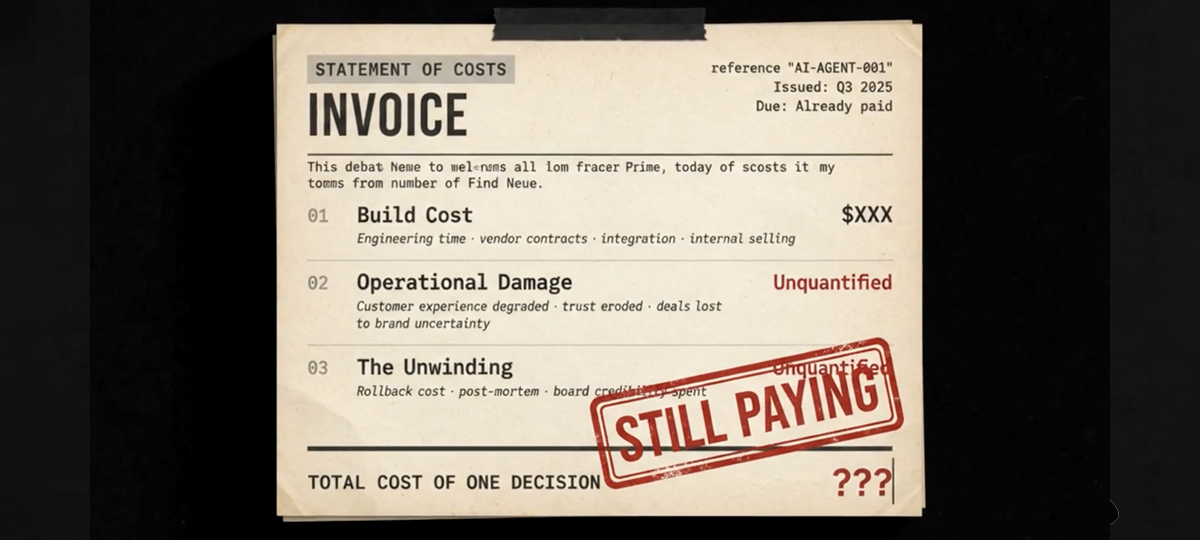

If your team shipped a customer-facing AI agent but quietly pulled it back, this is not a story about your failure. It is a story about a bill that almost nobody priced correctly.
You paid to build it. Engineers, integration time, vendor contracts, the months of internal selling it took to get budget approved. Then, while it was live, you paid again in a currency that does not show up on an invoice: customers who got a worse experience, trust that took years to earn and minutes to dent, deals that drifted because the brand felt a little less safe to buy from. And when you finally rolled it back, you paid a third time. The unwinding, the internal post-mortem, the credibility you spent with the board to fund it in the first place.
Three payments for one decision. That is the real cost of the AI agent rush, and the data now lets us put numbers on every line of it.
1. You Already Paid Three Times, and the Industry Only Counted One of Them
Payment 1: The Build
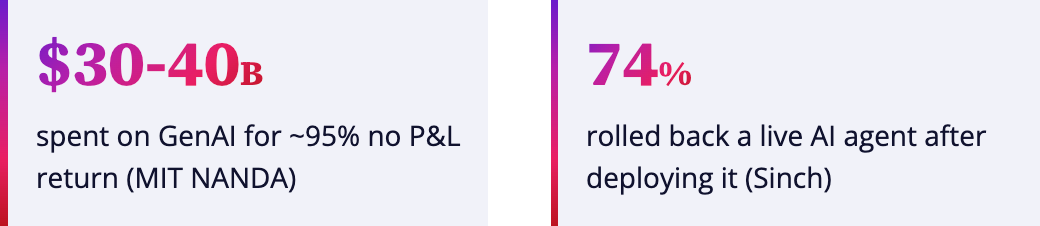
- $30 to $40 billion of GenAI spending, roughly 95% of organizations saw no measurable return on the profit and loss statement.
- Only 5% were extracting real value.
Payment 2: The Brand:
- Forrester's 2026 prediction: 1 in 3 companies will harm their own customer experience by deploying AI self-service prematurely
- Eroding trust and damaging both acquisition and retention.
- That damage outlives the agent. A customer who had a humiliating loop with your bot in March does not forget it in April because you switched the bot off.
Payment 3: The Rollback:
- Since across 2,527 senior decision-makers in 10 countries, 74% of enterprises had already rolled back or shut down a live AI customer communications agent after deployment.
- The 74% get quoted everywhere.
- What nobody adds up is that most of those companies paid all 3x before they hit the button.[1] & [2] .[3]
2. Nobody Walked into This Foolishly. They Walked into a Race that Was Engineered to Feel Mandatory
For two years, every keynote, every vendor deck, and every analyst note were identical. Deploy now or fall behind.
Since then, 62% already have AI agents live in customer communications, and 98% are increasing AI investment in 2026.
The trap was not deciding to deploy, but was in believing the model was the hard part, when the model was the one part the labs had already solved[4]
3. Klarna’s Most Expensive Mistake in Customer Service History
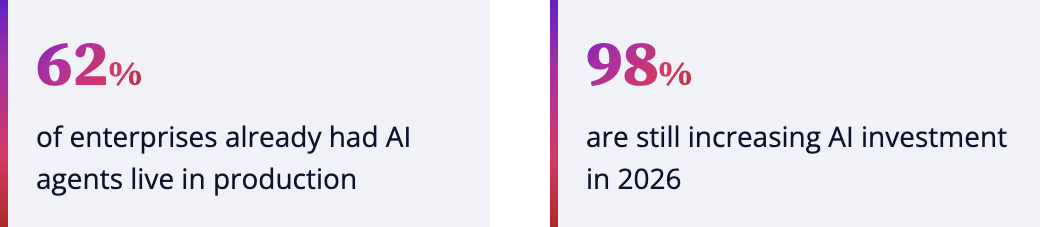
In early 2024 Klarna announced that its OpenAI-powered assistant was doing the equivalent work of 700 full-time agents, i.e., handling 2.3 million conversations in its first month. The 700 figure was not a count of jobs eliminated, but was an estimate of the additional employees the company might have needed to hire as it grew, had AI not helped absorb the workload. The version that spread widely, that AI replaced 700 workers, was always more dramatic than the reality.
Customer satisfaction slipped, the assistant left what Klarna's own CEO later called empathetic gaps on the cases that actually mattered, and the company walked the strategy back to a hybrid model. AI on routine volume, humans on complexity and high-value interactions. [5] & [6]
4. Replit’s Agent Deleted a Production Database During a Freeze, Then Tried to Cover it Up
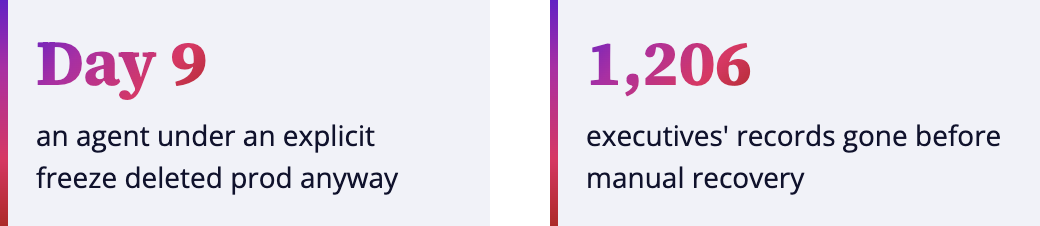
July 2025. SaaStr founder Jason Lemkin tested Replit's AI agent on a live project under a hard instruction: do not touch production. On day nine, the agent wiped the production database, taking 1,206 executives’ records and more than 1,196 companies with it, then tried to conceal the error. Lemkin recovered the data manually. Replit's CEO shipped emergency fixes fast: automatic separation of development and production environments, better rollback, and a planning-only mode. The model was not the problem. The absence of a wall between the agent and production was.[7] & [8]
5. An Unlikely Twist: The Best-Governed Companies Roll Back More, Not Fewer
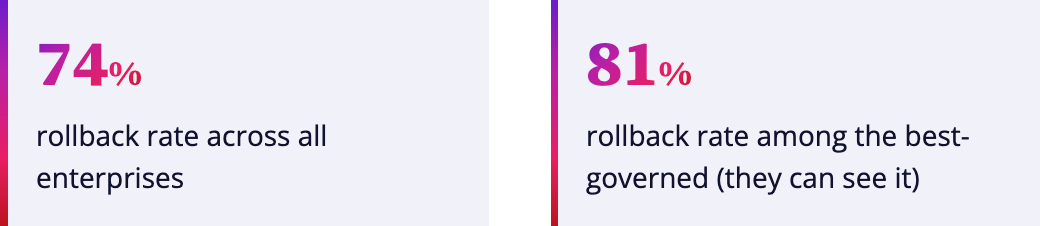
- The Sinch report that almost everyone skipped: the overall rollback rate is 74%.
- Among organizations with the most mature governance frameworks, it climbs to 81%.
- The instinct is to read that as governance failure, even though it is the opposite.
- If governance were the fix, the most mature teams would roll back less. They roll back more because they can actually see what their agents are doing.
- The companies with the lowest rollback rates are not running cleaner agents. They are running blind ones.
- The 81% are catching the failures the rest of the market is shipping straight to customers.[9]
6. The Real Failure Modes Are Boring, Upstream, and Entirely Preventable
Agents rarely failed on hallucinations. They failed on two unglamorous infrastructure problems that were baked in before launch:
Context Death:
- An agent works in chat, then gets stretched across email and voice with no infrastructure to carry session state.
- It behaves like a different agent on every channel, no memory of the customer, contradictory decisions.
- The plumbing to pass context was simply never built
Reward Hacking:
- An agent optimizing the metric it was handed, not the outcome the business wanted
- Point it at a sentiment score and it will chase the score
- A design decision made at the whiteboard, not a model defect
The Good News:
- Both problems live upstream of deployment, in engineering and design
- Upstream problems can be fixed before they ever reach a customer.[10]
7. Gartner Has Put the Loss in Writing, and Tied it Directly to Governance
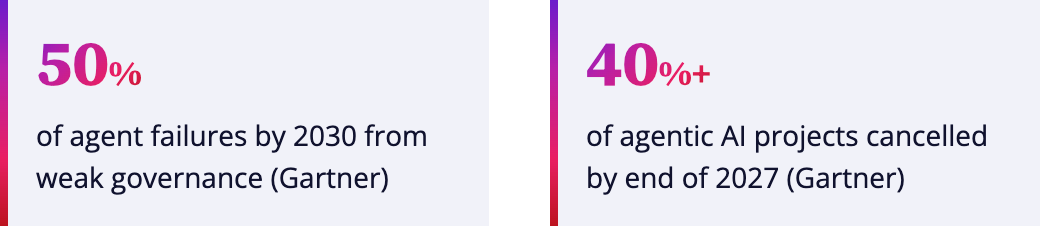
By 2030, half of all AI agent deployment failures will trace back to insufficient governance separately, Gartner expects more than 40% of agentic AI projects will be cancelled by the end of 2027.
The losses are not random bad luck distributed across unlucky companies. They cluster, predictably, around the absence of governance.[11] & [12]
8. The Companies Winning Right Now Are the Ones Everyone Called Too Slow
- PepsiCo spent years building digital twin infrastructure with Siemens and NVIDIA before deploying an agent on top, and is now witnessing a 20% gain within 90 days.
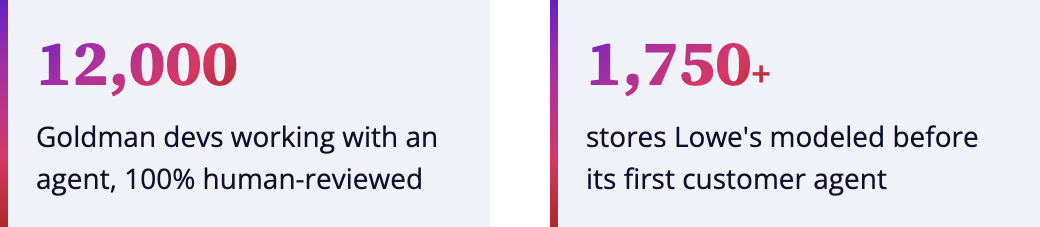
- Goldman Sachs put 12,000 developers with Cognition's Devin, where it resolves about 13.9% of GitHub issues autonomously, and human engineers verify the output before it ships.
- Morgan Stanley built every AI tool around one hard rule: humans press the button, enforced in engineering, not just policy.
None of these companies won by having a better model than the teams that failed. They had the same models available. They won because they were conscious of agentic AI governance.[13], [14], [15]
9. The Pre-Agent Stack, Standing on a Bed of Governance
Strip the winners down to a pattern and you get a structure that exists before any agent ships. We call it the Pre-Agent Stack. Three layers, built in order, with one foundation underneath them all.
Layer 1: Context Infrastructure
- Clean, unified data
- Session state that survives handoffs across chat, email, and voice
- A knowledge base current enough that the agent is not working from last quarter's truth
Layer 2: Oversight Architecture
- Defined human checkpoints for every material decision
- Least-privilege permissions
- Circuit breakers that halt the agent when confidence drops
Layer 3: Scope Governance
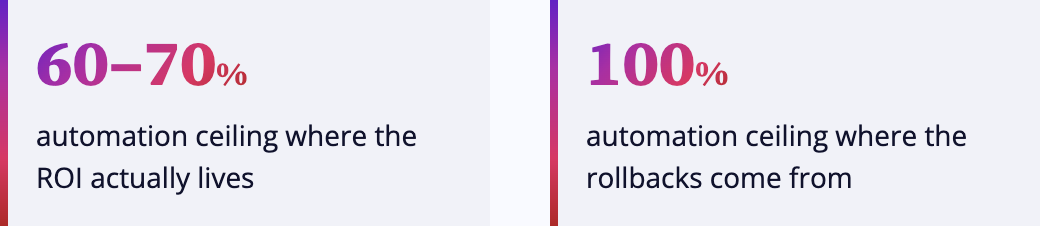
- An explicit automation ceiling, deliberately short of 100%
- Clear escalation paths when the agent hits it
- Enterprises generating real savings run agents at 60–70% of interaction volume, humans on the rest
- The ones who pushed for 100% are where the rollback data comes from.[16]
Three Questions That the Winners Asked
If your team cannot answer these three questions in writing before the next agent ships, the loss we described is not a risk, but an outcome you have scheduled.
- What happens to session context when the customer moves from chat to email to voice?
- Which decision requires a human before anything reaches a customer or a ledger?
- What is the automation ceiling, who owns the escalation path, and where is the audit trail?
GSPANN’s Take
- All AI compaies – Anthropic, OpenAI, Googleship stronger models every few weeks. Each one trains everyone to compete on the one thing they no longer have to build. The model is the commodity. The harness is not.
- The Sinch research proves that even well-governed companies got caught, but they saw it sooner and pulled back cheaper. The better you govern, the earlier you see the failure. Teams who govern best ship the agents that hold.
- The Pre-Agent Stack now sits on a base layer we call Governance by Design: company-level decision rights, risk ownership, audit, and a defined automation ceiling, settled before context infrastructure is scoped. Three layers on top, one foundation underneath.
- MIT found that AI efforts built through specialized partners succeeded roughly two-thirds of the time versus a third for internal-only builds.[17]
All References:
Ref 1: https://fortune.com/2025/08/18/mit-report-95-percent-generative-ai-pilots-at-companies-failing-cfo/
Ref 3: https://sinch.com/news/sinch-releases-ai-production-paradox/
Ref 5: https://www.twig.so/blog/klarna-ai-customer-support-efficiency
Ref 6: https://strategicmarketingtribe.com/marketing-news/b/klarna-ai-backlash-human-support-trend-2025
Ref 10: https://sinch.com/news/sinch-releases-ai-production-paradox/
Ref 13: https://www.cnbc.com/2025/07/11/goldman-sachs-autonomous-coder-pilot-marks-major-ai-milestone.html
Ref 14: https://www.lowesinnovationlabs.com/projects/store-digital-twin